

The Lakehouse Optimizer
The Augmented FinOps tool to maximize your Databricks lakehouse


The Lakehouse Optimizer: AI-powered
Can you quantify value in Databricks?
Increase your total data usage while decreasing your cost per TB
- Customer 1
- Customer 2
- Customer 3
Case Study
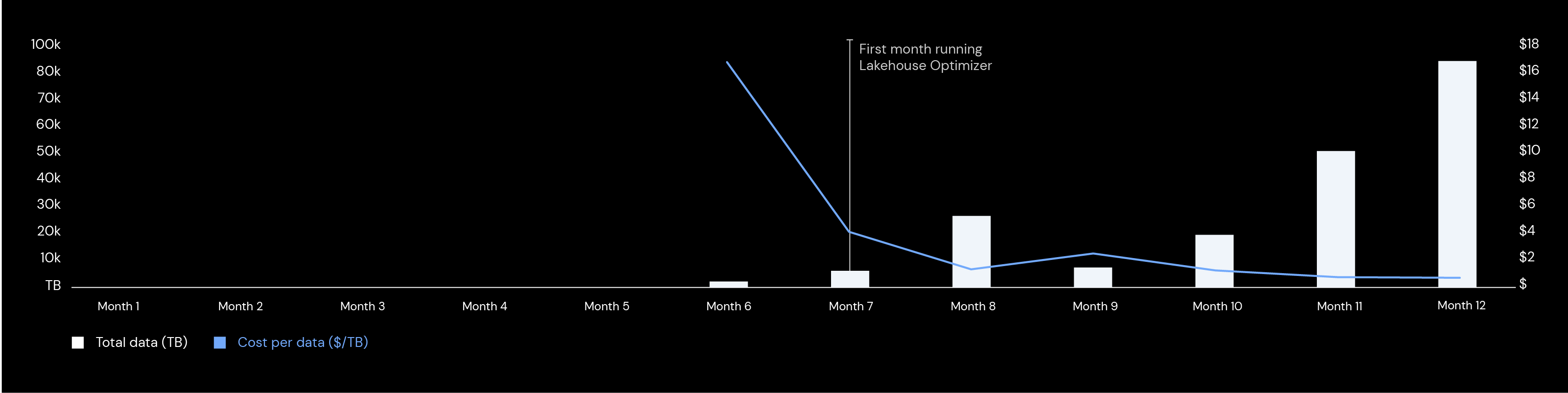
Total Data Usage / Cost per TB
60%
Reduction in storage costs
10%
Savings in compute resources
Summary
The company achieved significant cost and time savings by implementing efficient data reorganization and the Lakehouse Optimizer. This led to a substantial 60% reduction in storage costs, freeing up budget for other critical business initiatives. Additionally, a 10% savings in compute resources resulted in faster processing times, reduced operational overhead, and enhanced productivity, enabling more timely decision-making.

*Data based on real customer results
Case Study
Total Data Usage / Cost per TB
MONTH ONE
40%
Cost savings
MONTH TWO
25%
Additional cost savings
Summary
A large sustainable agriculture leader needed to improve their lakehouse’s scalability to handle food production and sustainability projects. The Lakehouse Optimizer enabled them to find architectural improvements allowing them to take on more projects while finding them considerable cost savings.

*Data based on real customer results
Case Study
Total Data Usage / Cost per TB
2 weeks
To see immediate value
$140k
Annual cost savings
Summary
A medical service pricing transparency company struggled with rising Databricks costs as their platform scaled. Blueprint’s Lakehouse Optimizer (LHO) was implemented to improve cost visibility and resource management. Within two weeks, the company saw a 35% reduction in overspend, positioning them for efficient growth and long-term success.
*Data based on real customer results
See value in
3 easy steps
Monitor
Databricks utilization
Discover
recommendations
Take action,
reduce costs
What is Augmented FinOps?
Blending human insight with AI to drive smarter decisions across the FinOps lifecycle.
Observe
Gain complete visibility into Databricks and cloud costs, including DBUs, clusters, Lakeflow, and jobs.
Analyze
Forecast
Optimize
Act on intelligent recommendations that quantify expected impact by job, workspace, or cluster.
Govern
Introducing Executive Insights Engine powered by LHO
Finally. Full observability for your Databricks Lakehouse.

See what matters across your Databricks Lakehouse and where to act next, all in one real-time executive view.

Observe
Continuous monitoring
Access full Databricks observability with granular visibility to identify and optimize inefficient data pipelines.

Intelligent org mapping
Allocate cost and measure performance by any department, project, or initiative.

Pool contention reporting
Gain a detailed understanding of idle VMs and how pools can alleviate resource contention.
Analyze
Cost management and control
Set thresholds and get notified for subscriptions, workflows, all-purpose clusters, Lakeflow, and other metrics to help control costs and better understand performance


Intelligent forecasting
Predict future cloud spend with high accuracy, enabling you to proactively manage budgets and prevent financial surprises. Align your financial planning with real-time data to stay ahead of potential cost overruns and optimize resource utilization.

Autoscaling insights
Identify inefficiencies and optimal autoscaling policy configurations.

Forecast
Optimization recommendations
Save 30% on total cost of ownership and improve performance by 50%.

Intelligent recommendations
Have individuals get notified when a recommendation is made for immediate action.
Optimize
Vendor consolidation and reconciliation
LHO reveals the exact cost of retrieving data from third-party systems for every job in Databricks, helping you identify migration opportunities and cost savings.


Vendor consolidation
Reduce complexity and vendor sprawl by pinpointing which jobs should be migrated.
Quantify the value of your data warehouse contracts.
Calculate the true total cost of ownership (TCO) across your data estate with LHO.

Govern
Unity Catalog migration
Inventory Hive Metastore objects, flag active dependencies, and generate prescriptive recommendations to reduce, so you migrate what matters and modernize with confidence.

Unity Catalog migration assessment
Facilitate a granular and accurate level of effort needed for the migration.
By running the assessment, you calculate your workspace’s Hive Metastore inventory and detects all active tables, jobs, runs, notebooks, and libraries within your Hive Metastore footprint.
LHO generates prescriptive recommendations within databases, tables, notebooks, and other objects to ensure migration success to Unity Catalog.
See how we compare
A leader in automation, optimization, & cost efficiency for Databricks environments.

Better understand the health of your Databricks environment and prevent over-provisioning to ensure optimal utilization with the Lakehouse Optimizer.

Report
Master High-Stakes Database Migrations: Reduce Risk and Accelerate AI Readiness (February 2026)
Customer success stories
Customer snaphots
Additional resources
Product documentation
Setup guides, feature walkthroughs, release notes and FAQs — maintained by the team that builds LHO.

Prerequisites, provisioning and first connection for either cloud.


Frequently asked questions
The Lakehouse Optimizer is available for a 30-day Free Trial in the Azure Marketplace to deploy on your own.
You can follow this guide for assistance. If you would rather have a guided experience, Blueprint can help you through your AWS or Azure deployment to get you up and running.
Every release is documented in our public [Release Notes] — the latest features, enhancements, and fixes, with archives back to 2023.
With LHO you can see not only your spend, but understand if its healthy or unhealthy, while getting transparency across the organization for the attributed spend. You can even drill all the way down to individual autoscaling events or code block execution of an individual job run for a workflow executed and see both Azure and Databricks costs represented.
Native views show spend; LHO shows spend health, job-level drivers, and trusted forecasts with recommendations and policy guardrails to prevent issues before they inflate costs.
The Lakehouse Optimizer is most commonly used by managers to receive alerts about critical issues, such as nearing budget limits, unexpected cost spikes, or unusual spending patterns. These alerts help managers quickly identify and address potential problems.
For developers, the Lakehouse Optimizer is often used while writing data pipelines. As they write code, LHO guides them in properly configuring clusters and selecting the right resources. This ensures that the code is optimized for the resources needed and that the appropriate tools are used for each task.
Absolutely.
The Lakehouse Optimizer offers features that help you identify relevant data and optimize your jobs or workflows. It provides detailed recommendations, total cost analysis, and other insights that guide you in making the necessary adjustments for improved performance and efficiency.
If you’re focused on specific jobs or clusters, start by reviewing the ones you’re responsible for and see what insights the Lakehouse Optimizer offers. Check if there are any recommendations for optimizing performance or reducing costs.
For those overseeing broader operations, it’s helpful to begin with a high-level view of your tenant or workspace. This will give you a clear picture of where spending is concentrated within Databricks and your cloud provider, providing a strong starting point for further analysis and optimization.
The Unity Catalog Migration Assessment evaluates your current Databricks environment to determine its readiness for migration to Unity Catalog. It also identifies the specific steps required for a successful transition. With Blueprint’s proven expertise, we have achieved a 100% success rate in Unity Catalog migrations.
LHO is deployed in your cloud tenant. We read Databricks and cloud billing telemetry, enrich it, and present insights without moving your governed data.
Teams typically see value in 2 weeks with visibility, alerts, and first optimizations live. Your current stack and governance posture determine exact timing.
No. LHO is designed for enablement. Recommendations and autoscaling insights help devs choose the right resources while they code, reducing rework and surprise bills.
Yes. Forecast quality and historical usage patterns help you commit with confidence (savings plans, reserved capacity) and track variance month-to-month.
